Rebecca Wade
15436247
Performing Arts Culture Across the World's Seven Continents
The musical environment
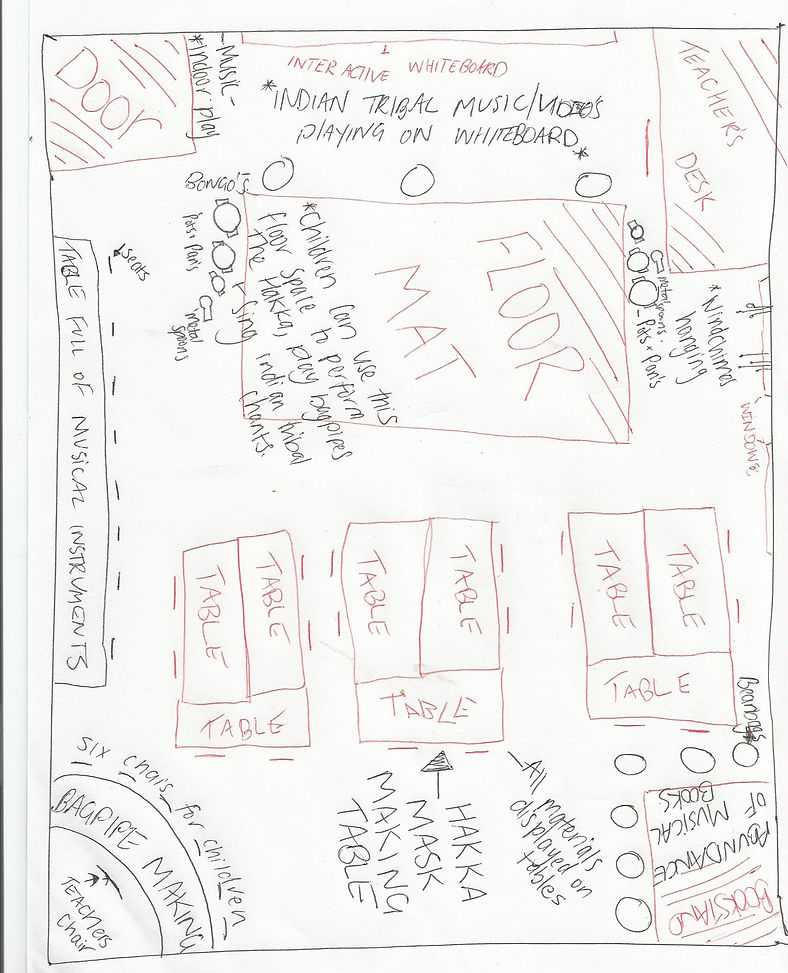
The environment was designed and constructed with deep consideration for the learing experiences intended for the children. When an early childhood environment is formed for social experiences, it begins to play a very crucial role in children's learning and development (Bullard, 2010). Therefore, the musical environment was desgined as a group environment, where the children are able to freely rotate around the classroom, experiencing multiple activities. The environment displays multiple tools and materials that correlate to the three continents that are dedicated to music; Europe with Ireland, Asia with India and Oceania with New Zealand. The room will contain an abundance of musical instruments native to the countries of Ireland, Mexico and New Zealand, as well as a range whimsical instruments such as wind chimes hanging by the windows. The instruments available to the children (which are a mixture of home-made, authentic and unconventional instruments), include a variety of percussion, wind and string instruments that allows them to explore musical elements such as dynamics, structure, pitch and timbre.
There will be stations set up for the children to create their own home-made instruments such as native masks to represent the men and women from New Zealand, and an area to watch and play their own Indian tribal music.
The educator will be stationed to help the children make their own home-made bag pipes by following Australian home-made instrument designer, Linsey Pollak's website.
The layout of the environment is designed for independent and social free play, that is child directed but also allows for the facilitation of scaffolding by the educator. The layout of the environment is outlined below: